Epiphany / O-Ring Specs
O-Ring Specs
Advertisement
The Epiphany ships stock with a Firebolt, and several sizes below carry the “Firebolt” name accordingly — if you’ve swapped to a different bolt, confirm sizes against that bolt’s own documentation.
Removing old o-rings: a 45° hook pick gives the best
angle to get under a seated o-ring and lever it out of its groove without
gouging the surface it seals against. If service has lagged, a dried-out
o-ring can deteriorate and crumble — in the worst case it comes out in
pieces rather than as one ring. Get every fragment out of the groove
before installing the replacement; even a small piece left behind will
keep the new o-ring from sealing.
Fire chamber / bolt
| Location | Size | Part # | Notes |
|---|---|---|---|
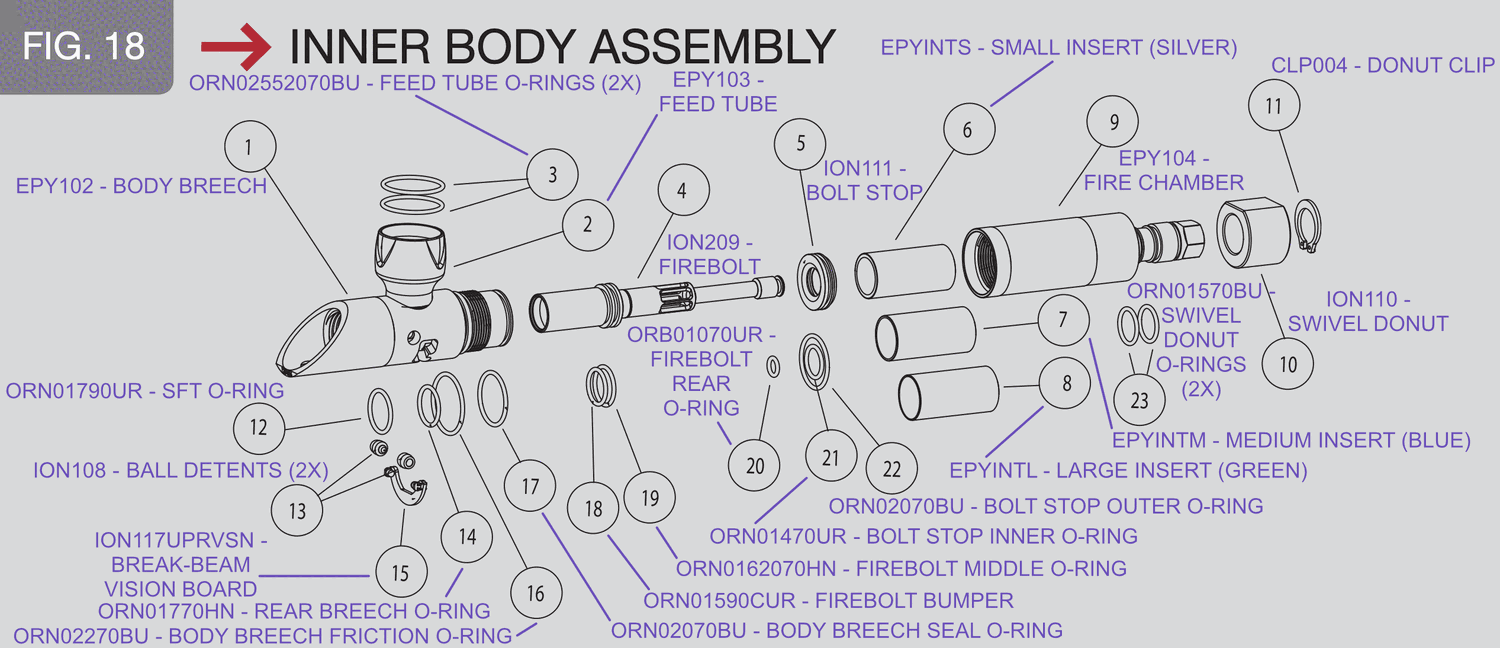
| SFT o-ring | 17/90 | ORN01790UR | Same size and role as on the standard Ion — common cause of paint breaking when worn. |
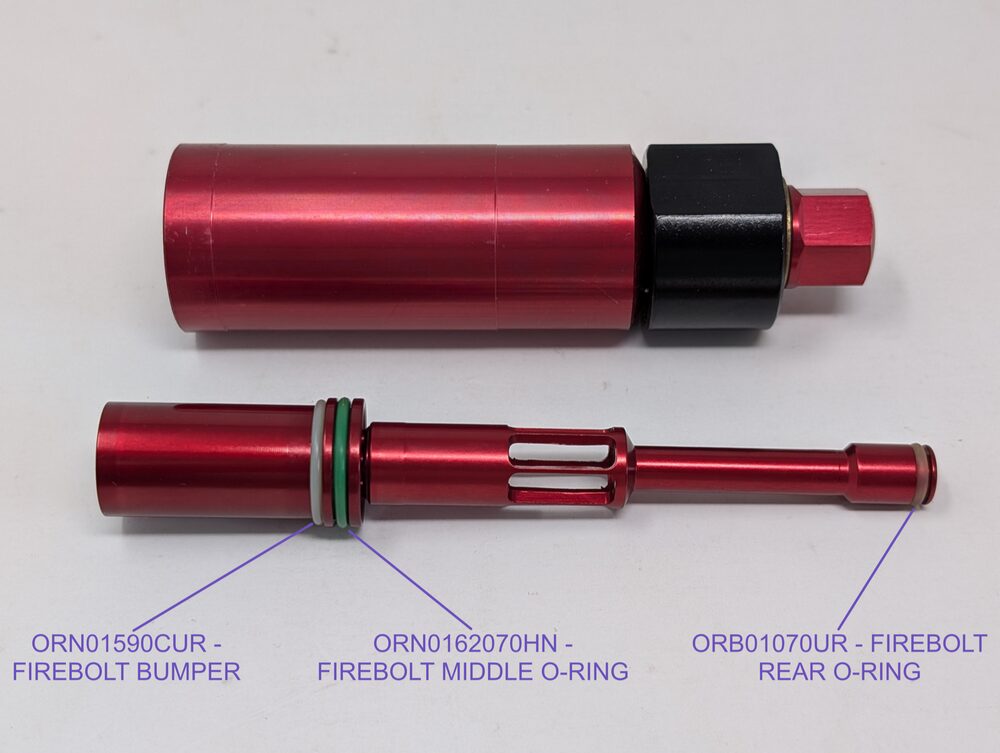
| Firebolt bumper | 15/90 | ORN01590CUR | The Ion 1.0 manual prints this as ORN01590UR — same dash size, durometer, and material (UR). No documentation found for what the extra "C" in the Epiphany manual's version denotes, so treat this as the same physical o-ring in practice. |
| Firebolt middle o-ring | 16×2mm / 70 | — | Material not confirmed for this one specifically — the standard Ion's equivalent (Bolt middle o-ring) is HN, but per this site's own rule of not assuming Epiphany parity without checking, that's not carried over here as fact. |
| Firebolt rear o-ring | 10/70 | ORN01070UR | Same number as the standard Ion's rear bolt o-ring. |
| Bolt stop inner o-ring | 14/70 | ORN01470UR | Matches the standard Ion bolt stop sizing — this is the same physical part (Smart Parts #ION111) across Ion 1.0/2.0/Epiphany. |
| Bolt stop outer o-ring | 20/70 | ORN02070BU | Matches the standard Ion bolt stop sizing — same shared part (#ION111) as the inner o-ring above. |
| Body breech friction o-ring | 22/70 | ORN02270BU | Matches the standard Ion sizing. |
| Body breech seal o-ring | 20/70 | ORN02070BU | Matches the standard Ion sizing. |
| Rear breech o-ring | 17/70 | ORN01770HN | Matches the standard Ion sizing. |
| Swivel donut o-rings (×2) | 15/70 | ORN01570BU | Same size as the standard Ion, but Buna-N (BU) here — Ion 1.0 uses urethane (UR) — per each manual's own Fig. 18. Part number constructed from the site's own established Smart Parts numbering pattern (dash size + durometer + material code), not independently found written out in either manual. Underneath the donut, once the donut clip is removed — see Firing Assembly for the removal procedure. |
| Feed tube friction o-rings (×2) | 5×25mm ID | ORN02552070BU | Same part as the standard Ion — the Epiphany's feedneck style just uses two of them instead of three, per each manual's own Fig. 18. |
| Ball detent bore (×2) | 6.35mm diameter | — | Matches the standard Ion's bore size — measured directly on an Epiphany body breech, not manual-sourced. |
Regulator
| Location | Size | Part # | Notes |
|---|---|---|---|
| Reg cover friction o-ring | 22/70 | — | Epiphany-only, so there's no standard-Ion equivalent to cross-reference for a part number, and material isn't confirmed either. The standard Ion's grip is rubber all the way through, so the rubber itself grips the metal regulator body directly — no o-ring needed. The Epiphany's cover has metal in it (likely a magnesium finish, matching the plated body), which would otherwise sit metal-on-metal against the regulator body — too slippery to stay put on its own. This o-ring sits between them, adding the friction that holds the cover in place and keeps it from rotating freely around the body. |
| Regulator o-ring | 15/90 | — | Material not confirmed for this specific row — a standard CO2 bottle o-ring works as a substitute if you're stuck without the exact part. |
Higher-pressure hoses and solenoid required. Most Ion
low-pressure hoses can already handle Epiphany pressure — check for a
rating printed on the hose itself — but the Epiphany-specific solenoid is
required regardless; a standard Ion solenoid isn't built to deliver
consistent shot-to-shot force at Epiphany pressures. Epiphany-rated
solenoids and circuit boards are identifiable by a red protective coil
wrap with a black Ion logo.